
Getting your first visitors is one of the hardest parts of starting a blog.
You can spend days writing articles, choose a good domain name, install WordPress and publish your content, but none of that guarantees people will find your website.
The good news is that you do not need thousands of dollars in advertising to get your first 1,000 visitors.
A new blog can gradually build traffic through useful content, search engine optimization, internal linking, Pinterest, social platforms and consistent promotion. The key is to stop thinking about traffic as something you can get overnight and start building a system that brings visitors repeatedly.
In this guide, you will learn how to get your first 1000 blog visitors without relying on paid advertising, even if your website is relatively new.
What Does 1,000 Blog Visitors Actually Mean?
Before discussing traffic strategies, it is important to understand what the goal means.
Getting 1,000 visitors does not necessarily mean getting 1,000 visitors in one day.
For a new website, reaching the first 1,000 visitors over several weeks or months is a much more realistic target.
For example, you could reach:
- 10 visitors per day at the beginning
- 25 visitors per day as your content grows
- 50 visitors per day after gaining some search visibility
- 100+ visitors per day once several articles begin attracting traffic
The exact timeline will vary depending on your niche, competition, content quality and promotion.
The important thing is to build traffic that can continue growing instead of relying on one temporary traffic source.
1. Start With a Clear Blog Topic
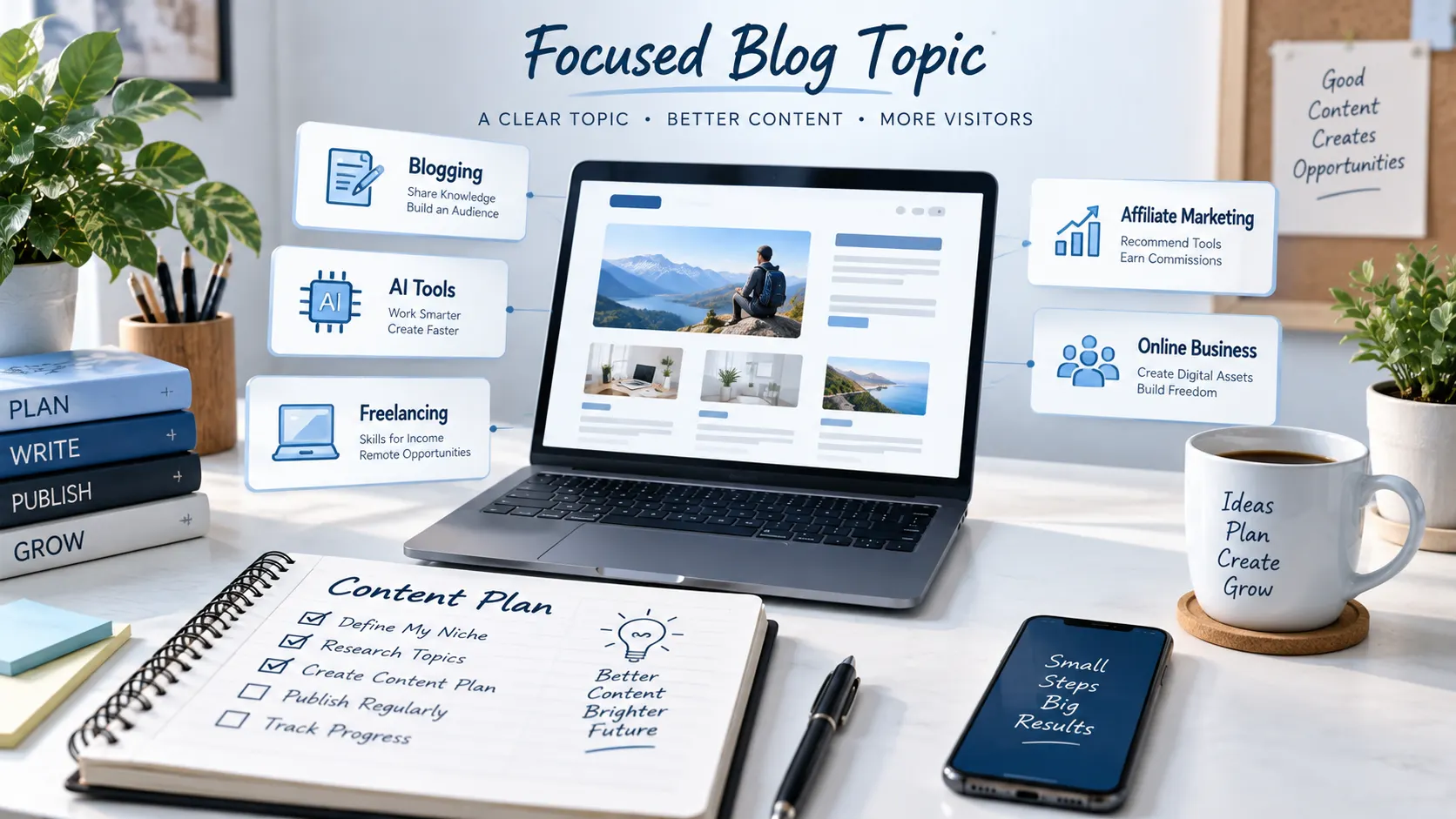
One of the biggest mistakes new bloggers make is trying to write about everything.
A website covering blogging, cooking, fitness, technology, travel, finance and entertainment at the same time will have difficulty developing a clear identity.
Instead, start with a specific topic and audience.
For example, a blog about online business could focus on:
- Blogging for beginners
- Affiliate marketing
- AI tools
- Freelancing
- Digital products
- Online business tools
A focused topic makes it easier to create related articles and connect them with internal links.
If you are still deciding what your blog should focus on, read our guide on How to Choose a Blog Niche in 2026.
Your goal is not to choose the world’s perfect niche.
Your goal is to choose a topic where you can consistently create useful content for a specific group of readers.
2. Create Articles Around Real Questions
Do not start by asking: “What keyword can I put into an article?”
Start by asking: “What problem is my reader trying to solve?”
That small change can significantly improve your content strategy.
For example, someone interested in blogging might search for:
- How do I start a blog?
- How do I get visitors to my blog?
- Why is my blog not getting traffic?
- How do I find keywords?
- How often should I publish?
- How can I make money from a blog?
- What are the best blogging tools?
Each question can become a useful article.
This approach also helps you avoid publishing several articles that say essentially the same thing with slightly different titles.
3. Focus on Long-Tail Keywords
New websites usually have a difficult time competing for extremely broad keywords.
Trying to rank immediately for a term such as “blogging” is not a realistic strategy for most new websites.
Instead, target more specific searches.
For example:
Broad keyword: blogging
More specific keyword: how to get traffic to a new blog
Even more specific: how to get your first 1000 blog visitors without paid ads
Long-tail searches usually have a clearer purpose.
Someone searching for a specific problem is often looking for a specific solution.
That gives your article a better opportunity to satisfy the search intent.
Do not force the exact keyword into every paragraph. Use natural variations and related terms where they make sense.
4. Publish Fewer, Better Articles
Publishing 50 weak articles will not automatically produce more traffic than publishing 15 genuinely useful ones.
Every article should have a clear purpose.
Before publishing, ask:
- Does this article answer a real question?
- Is the information useful?
- Is it easy for a beginner to understand?
- Have I removed unnecessary repetition?
- Are the facts accurate?
- Does the article provide something useful beyond a basic definition?
- Does it link naturally to other relevant pages on my website?
A good article should leave the reader feeling that their question has actually been answered.
This is particularly important for websites that use affiliate links. Google says AdSense publishers should provide unique and relevant content and avoid cookie-cutter affiliate pages that add little value.
5. Optimize the Article for Search Engines
SEO does not mean repeating your keyword dozens of times.
A properly optimized article should have a clear structure.
Use:
- One clear H1
- Logical H2 sections
- H3 headings when necessary
- Short paragraphs
- Descriptive image alt text
- A useful meta title
- A natural meta description
- Relevant internal links
- A clean URL
- Useful information near the beginning
Your title should tell the reader exactly what they will learn.
For example:
Weak: Blog Traffic Tips
Better: How to Get Your First 1,000 Blog Visitors in 2026
The second title immediately communicates the subject and the expected outcome.
Do not try to make every heading contain a keyword. Write headings for humans first.
6. Build Internal Links Between Related Articles
Internal linking is one of the easiest improvements you can make to a growing website.
Suppose someone is reading an article about getting blog traffic.
You could naturally link to:
- How to Start a Blog
- How to Choose a Blog Niche
- Best AI Writing Tools for Bloggers
- How to Start Affiliate Marketing
- Best AI Tools for Affiliate Marketing
These links give readers another useful resource instead of forcing them to return to Google to find the next answer.
They also help search engines understand how the pages on your website are related.
Bing’s current webmaster guidance specifically recommends making important URLs reachable through crawlable internal links and using relevant anchor text.
Example
Instead of writing: Click here to read more.
Use: If you are still building your website, our step-by-step guide to starting a blog explains the process from choosing your topic to publishing your first article.
That gives the reader context before clicking.
7. Use Pinterest as a Traffic Channel
Pinterest can be useful for bloggers because individual pins can continue sending visitors to an article after they are published.
Create several useful pins for your best articles rather than creating one graphic and forgetting about it.
For example, this article could have pins with angles such as:
- How to Get Your First 1,000 Blog Visitors
- 10 Free Ways to Get Blog Traffic
- New Blog? Here’s How to Get Your First Visitors
- How to Grow Blog Traffic Without Paid Ads
Each pin should lead to the relevant article.
The important part is that the Pinterest content should accurately represent what the visitor will find after clicking.
Do not use exaggerated headlines simply to generate clicks.
8. Share Your Articles Where Your Readers Actually Spend Time
Publishing an article and waiting for Google to discover it is not a complete traffic strategy.
Share useful content where your potential readers already spend time.
Depending on your audience, that could include:
- Facebook groups
- Relevant online communities
- Forums
- Email newsletters
- Industry communities
However, avoid becoming the person who drops a link into every discussion.
Instead, participate in the conversation.
If someone asks a question that your article genuinely answers, you can share the resource where appropriate.
The goal is to become useful, not promotional.
9. Update Older Articles
Publishing new content is important, but you should not ignore the articles already on your website. Older posts can often become more useful and competitive when you review and improve them regularly.
You do not need to rewrite every article from scratch. In many cases, a few meaningful updates can make a page clearer, more accurate, and more helpful to readers.
What should you check?
When reviewing an older article, look for:
- Outdated information or statistics
- Broken or irrelevant links
- Missing information that readers may need
- Sections that are difficult to understand
- Repetitive or unnecessary paragraphs
- Weak introductions or conclusions
- Missing internal links to relevant content
- Images that need better descriptions or alt text
- Titles and meta descriptions that no longer accurately represent the article
You can also look at the search queries bringing impressions to the page. Sometimes an article begins appearing for related searches that you did not originally target. Those queries can reveal useful topics or questions that deserve clearer coverage.
However, avoid changing an article simply to make it appear “fresh.” An update should add genuine value rather than just changing a few words or the publication date.
A useful approach is to review your most important articles periodically and improve them when there is something meaningful to add or correct. This helps keep your content useful for both new and returning readers.
What You Should NOT Do to Get Blog Traffic
There are plenty of shortcuts advertised online.
Most are not worth your time.
Don’t buy cheap traffic
A large number of low-quality visitors is not the same as a useful audience.
Don’t spam communities
Posting your link everywhere can damage your reputation and may violate community rules.
Don’t publish dozens of nearly identical AI articles
Changing a few words in the title and rewriting the same information does not create a useful content library.
Don’t stuff keywords into every paragraph
Write naturally. If a sentence sounds strange because you are trying to insert a keyword, remove it.
Don’t create articles solely for advertisements
Your content should have a purpose beyond displaying ads.
Google’s AdSense guidance emphasizes unique, relevant content and warns against pages with little original value.
Don’t expect instant results
SEO is a long-term traffic channel.
A new article may need time to be crawled, indexed and evaluated.
Final Thoughts
Getting your first 1,000 blog visitors is not about finding one secret traffic method.
It is about building several reliable traffic sources around genuinely useful content.
Start with a focused topic. Create articles that answer specific questions. Target realistic search terms. Connect related pages with internal links. Promote your best content through channels such as Pinterest and relevant communities. Then use your search data to understand what your audience wants next.
Most importantly, don’t sacrifice quality just to increase your publishing speed.
A small collection of useful articles can become the foundation for a much larger website.
Your first 1,000 visitors are not the final goal.
They are proof that your content is beginning to reach the right people.
Frequently Asked Questions (FAQs)
How can I get my first 1,000 blog visitors?
Start by publishing useful articles around specific questions your audience searches for. Combine SEO, internal linking, Pinterest, relevant communities and consistent content updates rather than relying on one traffic source.
How can I get blog traffic without paying for ads?
You can use organic search, Pinterest, social media, online communities, email marketing and referrals. SEO is usually the most important long-term strategy for a content website.
How long does it take to get 1,000 blog visitors?
There is no fixed timeline. A new website may take weeks or months depending on the topic, competition, content quality, promotion and search visibility.
How many blog posts do I need to get 1,000 visitors?
There is no magic number. Ten excellent articles can outperform 50 weak ones. Focus on the usefulness and relevance of each article rather than trying to hit a specific post count.
Can Pinterest help a new blog get traffic?
Yes. Pinterest can be a useful additional traffic source for content websites, particularly when articles have visually appealing topics that people are likely to save or share. However, it should complement your broader traffic strategy rather than replace SEO.
Should I buy traffic for my new blog?
I would not recommend buying low-quality traffic simply to increase visitor numbers. Focus on attracting people who are genuinely interested in your content and can become returning readers.